Thursday, December 10, 2020

NY missive no 175 - Wabi Sabi

Since reading Tanizaki’s In Praise of Shadows a while back I had lost touch with the concept of “wabi sabi”. Then I reconnected with it again when I came across an article about wabi sabi in architecture. It’s one of those terms whose meaning is nestled so securely in its original language and application, in this case Japanese, that much gets lost in translation. From what I’ve read I’m taking it to mean simplicity (not shallow, but deep simplicity), combined with the beauty that objects acquire over time with use. Perhaps the most wabi sabi object we have is the saucepan that C’s mom used to use, with gentle dents in its matte surface from much stirring over the years. 

I imagine wabi sabi can apply to relationships as well as material things. The way that they are formed by accumulated moments and focused interaction – the times that, for example, C has bought me a new item of clothing having spotted I need it and realized I wouldn’t get round to doing so myself, or rubbed my feet at the end of the day, or said something that makes me realize he knows me even better than I do myself (which is often). The way that relationships acquire completely unique markers, and yes, blemishes and imperfections, all of which are infused with an inner light that makes them whole.

Sunday, November 22, 2020

NY missive no 174 - Rosebud


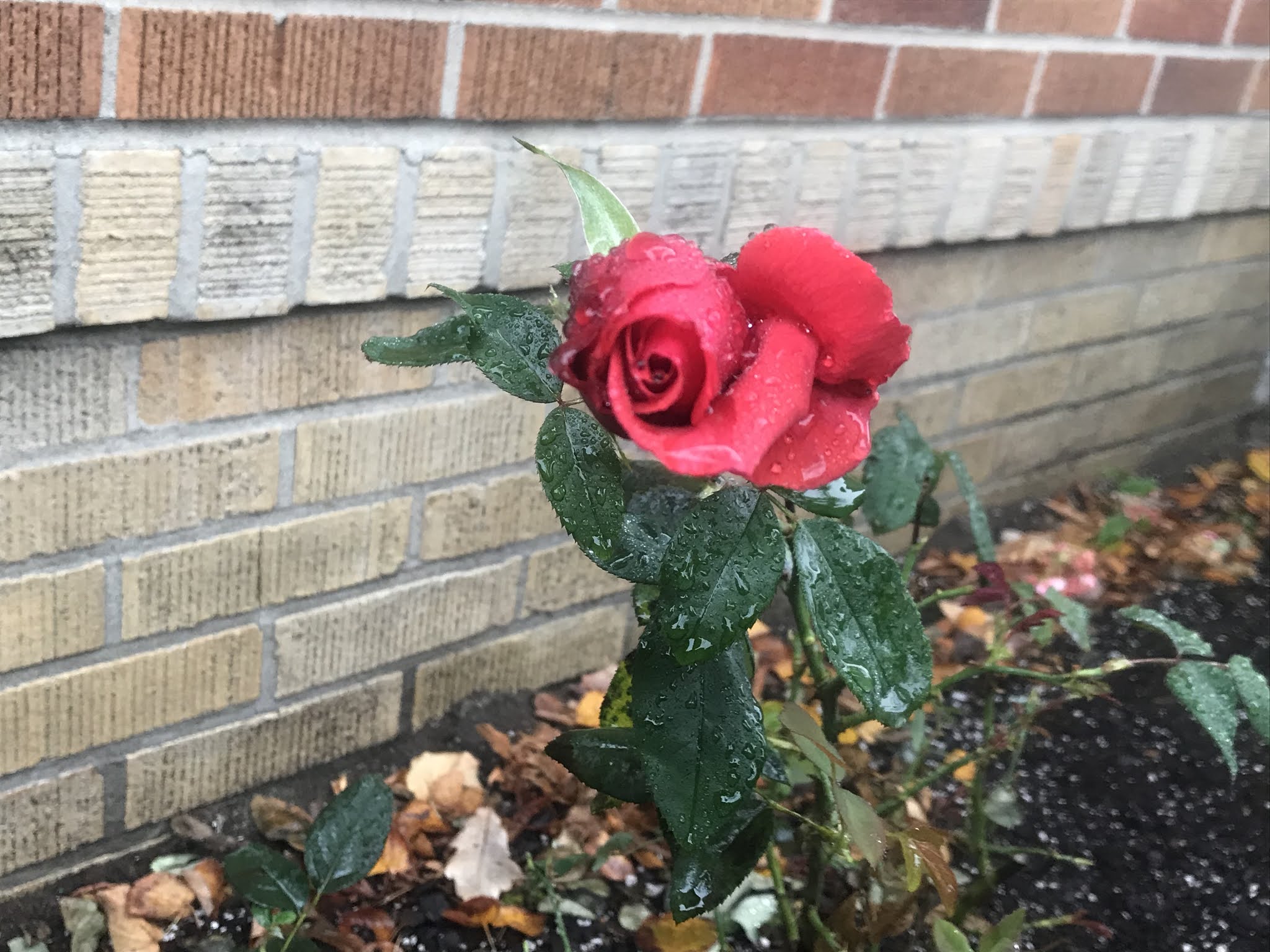
I’ve never been so happy to see a rosebud.

Through these months of having a smaller radius of existence the roses of Astoria, which come out around April, have taken on extra meaning. 


When the video of the killing of George Floyd came out, their beauty was jarring. At the time I wrote:


How to reconcile

The roses’ beauty

With the image 

Of George Floyd’s head

Crushed beneath

Derek Chauvin’s knee

On the road

Crying out

I can’t breathe

Crying out

Please

Crying out Mama

Until he breathes no more.


Through the Summer, I would often walk around the block before the kids woke up, looping back up along a stretch of 36th Street. There are roses all along that stretch, where each building has a small garden in front, and I would pause to watch their poses, tilting against walls or just growing upwards, bobbing gently on the end of their stems. Solidarity roses, and roses in abundant clusters. (Now that the kids are back at school after the Summer but virtually, all four of us walk that block together after breakfast, as a pretend “walk to school”).


Back in August I decided to try planting roses of our own in front of the house. Off I went on one of my infrequent missions to Home Depot on Northern Boulevard. I walked back with two little rose bushes in our maroon laundry cart. The laundry cart drives home for me the incongruity of having a house (albeit mostly still owned by the bank) and not a car. It means we don’t use the cart for laundry because we have a washing machine, but that we do use it as a surrogate car whenever we have to move more than we can carry by hand. It came in very handy in the depths of the pandemic when we’d venture out, masked and gloved-up, to stock up on food for multiple days rather than our usual daily food shopping.


So there I am, wheels rattling along the sidewalks, thorny branches sticking out. Back at home I start working on the holes to plant them, which means moving the garbage bins around to the side. I soon had doubts, and that defeating feeling of not being able to do something that you were hoping to do and that felt important. The ground was dry, hard, and stony. Worse than that, the evergreen shrub in front of where I was digging had a thick patchwork of spindly roots, so dense that it started to feel ridiculous trying to dig through them. How was a rose bush going to survive, let alone thrive, here?


I wiggled and dug and shook out the dry mud till two shallow holes began to appear. I tipped some potting soil around them to raise the surrounding ground and make them seem deeper. 


“You want to do planting in ‘R’ months”, said neighbor M from two doors along, who misses nothing. 


“Sorry?”


“Months with R in them. March, April, September, October. Not November or December of course, but those middle months that have an R.”


It was the last week in August. 


Doubting the holes were deep enough but not being able to get any further, I lowered the rose bushes in and packed them tightly with soil. Each time I came in and out of the house I checked up on them, and watered them most days. They looked decidedly shaky, and took it in turns to have their leaves get black spots. Then a bud appeared on the bush furthest from the door. Now each time I passed I willed the bud to still be there, and to open. Red petals began peeking through. It opened out into a fully formed rose.


Saturday, October 24, 2020

NY missive no 173 - Sobre Tumbas y Heroes


My main reading companion over the past two months of the pandemic has been Sobre Héroes y Tumbas (On Heroes and Tombs) by Ernesto Sabato. I thought I’d take the plunge despite knowing in advance that it’s a dark read, which may not be that suitable - or maybe too suitable - for these times of global pandemic and economic downturn. 

I say companion in the fullest sense of the word. Good books infuse themselves with whatever’s going on in your life and thoughts as you read them – like a constant conversation between the two, tapping into the essence of being human, transcending the distance of time and place that might separate reader from book even while reminding us that place and time (infinite, finite) are in fact two of the elements that define our shared experience and therefore unite us.

The book takes place, mostly, in early 1950s Buenos Aires, a moment of transition and of deep divisions between the old and the new. There’s hope (some) and despair (a lot), and uncertainty about what’s to come. In other words, strong resonance with the period we’re living through now. The sense of transition plays out in the Buenos Aires seasons as well, as Summer slips into fall, just as is happening now in New York albeit at a different point in the calendar year. 

About half way through: 

“Fueron tiempos de tristeza meditativa [para Martin]: todavía no habían llegado los días de caótica y tenebrosa tristeza. Parecía el animo adecuado a aquel otoño de Buenos Aires, otoño no solo de hojas secas y de cielos grises y de lloviznas sino también de desconcierto, de neblinoso descontento. Todos estaban recelosos de todos, las gentes hablaban lenguajes diferentes, los corazones no latían al mismo tiempo…: había dos naciones en el mismo país, y esas naciones eran mortales enemigas, se observan torvamente, estaban resentidas entre si.”

“Those were times of meditative sadness [for Martin]: the days of chaotic and dark sadness had not yet arrived. It seemed the right mood for that Autumn in Buenos Aires, an Autumn not only of dry leaves and gray skies and drizzle but also of confusion, of foggy discontent. Everyone was suspicious of everyone, people spoke different languages, hearts did not beat at the same time ...: there were two nations in the same country [!!], and those nations were mortal enemies, they watched each other grimly, they resented each other."

At the centre of the novel is the relationship between Alejandra, her spirit broken by past and present members of her aristocratic family – including her deeply disturbed father Fernando whose raging, rambling “Essay on the Blind” sits like a gaping fissure in the middle of the book – and the young, almost penniless (particularly after losing his job at a printing press) Martin, who is trying to find his way in life and the world, and in the same vein trying to find his way to understanding Alejandra, all the while recognizing that that there is an irreconcilable distance between them. That’s one of the many strands of the book’s beauty and tragedy, recognizing that people need each other in order to find their reason for being and yet can never know one another fully: the book rises and falls between closeness and apartness.

Bruno, the friend-narrator who guides us through the novel, reinforces that yearning for closeness after a night-time scene when he’s been looking out from a parapet across Buenos Aires, and all meaning seems to start crumbling away. Then he encounters a street dog. The dog is hungry, anxious for love. Bruno gives him some food and carries him to a sheltered space to keep warm, and something “enigmatic but powerful” seems to bring meaning back to Bruno’s own existence. 

Sabato-Bruno-narrator wonders at points throughout the novel about language, writing and what they are in relation to life (this is an Argentinean literary tome after all). In the midst of the fragile World when all’s in flux, at least, he says, the act of writing makes it possible to hold things still. 

“Las gaviotas iban y venían.

“Todo era tan frágil, tan transitorio. Escribir al menos para eso, para eternizar algo pasajero.” 


“The seagulls came and went.
Everything was so fragile, so transitory. To write at least for that, to eternalize something passing.”

And there’s the challenge of trying to convey life and its complexity through the lives of individuals, but he comes to conclude that that is the only way. 

“La verdad, se decía, sonriendo con ironía. La verdad. Bueno, digamos: Una verdad, ¿pero no era una verdad la verdad? ¿No se alcanzaba ‘la’ verdad profundizando en un solo corazón? ¿No eran al fin idénticos todos los corazones?”

“The truth, he told himself, smiling ironically. The truth. Well, let’s say: A truth, but wasn’t a truth the truth? Don’t we reach ‘the’ truth by going deep into a single heart? At the end of day aren’t all hearts the same?”

At one point (I’ve lost now where I underlined it) he shares the idea that our lives are lived as drafts, as a “borrador”, until they are over. 

Throughout the book, moments that may have seemed small or meaningless at the time they happened have weight in retrospect, like there’s a conversation going back and forth over time. I had that feeling, vividly, on the beach at Long Branch New Jersey at the beginning of September, on a surprise trip there that C organized for us. JNH, CMH and I were combing the sand for shells. We were on a patch scattered with mussel shells, tiny crab exoskeletons and the occasional cowrie, with the waves crashing beside us. I was immediately connected back to the times as a child, and young adult too, walking beaches with Mum looking for shells, both of us quiet, heads down, picking up little pieces of beauty when we spotted them. Those moments with her and with the boys now felt so complete given the connection between them, meaningful in a way that doesn’t need any explanation. I brought a little handful of shells (but not crab exoskeletons) home to keep on my chest of drawers.

Sunday, September 27, 2020

NY missive no 172 - At Astoria Heights playground

Two teenage boys on the bench next to me at Astoria Heights playground, talking in a blend of Portuguese and English, while JNH and CMH practice their soccer goals nearby. “Call her,” says one.

The other makes a call. “Hey, we’re hanging in the Park if you want to join”. And when he hangs up, “she said she might!”. 


As they head round to the basketball courts, one is saying “my Mom wants me to go fully virtual now.”


It’s in between Summer vacation and the start of school, with its staggered, mostly online and uncertain start because of Covid. It’s in between whether the girl comes to the park or not. Most of our lives happen in the in-between times, between “moments” which are more like punctuation, important but actually not essential, creating rhythm. The other day I read that the Inca have two forms of constellation: one formed by the stars, and one by the dark spaces between the stars in the Milky Way. 


Sunday, September 13, 2020

NY missive no 171 - Breath

The East River waves / break / on its shore / and fall back / with my breath / come in / out, long, / in, and the sound of / sea glass / tinkling under water / the glass is in / my throat / comfort and pain / at once.

Sunday, August 30, 2020

NY missive no 170 - Moving

A lot of people are moving. Each weekend the streets of Queens are dotted with U Hauls. I imagine it’s even more the case in Manhattan (which we’ve only been to a few times these past few months – it seems like another World although it’s just across the river). Around 31st Avenue there are often guys from the “Piece of Cake” moving company with their purple t-shirts, I guess their base is there. 

And just now as I was writing, a big spider packed up her web. I had no idea they did that. I thought she was spinning it at first, a large web stretching from a pole to the wall of the next door house, but realized she was gathering the threads up with her front legs - they disappeared as she moved until the web was no more.

NY missive no 169 - Listening

Recently I’ve been mourning language. Or more like lamenting its loss, cleaving to words used with care and creation, or neither of those but with authenticity, and feeling deadened by the torrents of words detached from souls.

Much of language seems like a superhighway, charging through space on a predetermined route to get us, anyone, from point a to point b without paying much attention to what’s around us, provided we reach that destination of the message and if we are not careful we will be lulled like on highways at night when the street lamps flash by, one, two, three, four five, six, seven, one, two, whoosh, whoosh. (Of course there will be some crashes along the way). What I miss is language that comes from the gut. Person to person. Unfiltered, unedited, vernacular, surprising, agenda-free, that’s when you want to listen.

Which makes me realize that this is a question of choice, of attention. Of choosing to not to be barraged and instead create the space to read and to hear the wonderful words of mystery and love and power that are out there yet so easily passed by.

(Speaking of which - read the "landless acknowledgement" at the start of Nate Marshall's new book of poems, Finna. Then the poems too!)

When Arundhati Roy talked about moving “lightly” through this portal that’s the pandemic, the lightly can be read in many ways. Yes, lighter as in freer from the polluting, divisive baggage of the path we were on before (wouldn’t that be good?!) and lighter to imagine and fight for another World. Also, lighter so that we have more capacity for attention.