Showing posts with label Wall Street. Show all posts

Monday, September 24, 2012

New York missive 120 - Limits of language, the Staten Island ferry & Stone Street Oyster Festival

Reading a simple story book with JNH the other day I was reminded about the wonder of language. How images in a cave have evolved into sentences on a page (whether paper or electronic). How a combination of letters in a children’s book can spell the word BUTTERFLY, which means butterfly, which gets the child reader thinking of butterflies and remembering butterflies he has seen. Those butterflies may be red, they may be white. Were the butterflies in JNH's mind flying, or sunning themselves on a brick wall?

Language creates worlds and is full of potential. And yet...it is so limited. For people who speak languages that use the roman alphabet, all we have is those 26 shapes and combinations of them to communicate. People speaking other languages are similarly restricted by their alphabets. (For linguistic communication, that is – the spectrum of communication forms that are not part of language, like facial expressions, gestures etc., may account for more than language).

The way to come to terms with it perhaps is to see that restriction as part of its effectiveness. Just as the French Oulipo (“Ouvroir de Littérature Potentielle”) writers saw imposed constraints – such as writing without a particular letter – as opening up expressive potential, so language itself could be seen as a constraint that does just that.

*****************************************

From Astoria Park, JNH saw boats sailing and motoring up East River. He requested to go on one, in the way that two year olds do: "I want to go on a boat." More an announcement than a request. During the week afterwards, he would add, "a sailing boat," followed by a serious nod. I explained that sailing boats are lots of fun but are hard to come by. I said that what we could do though, is go on a big orange boat, aka the Staten Island ferry.

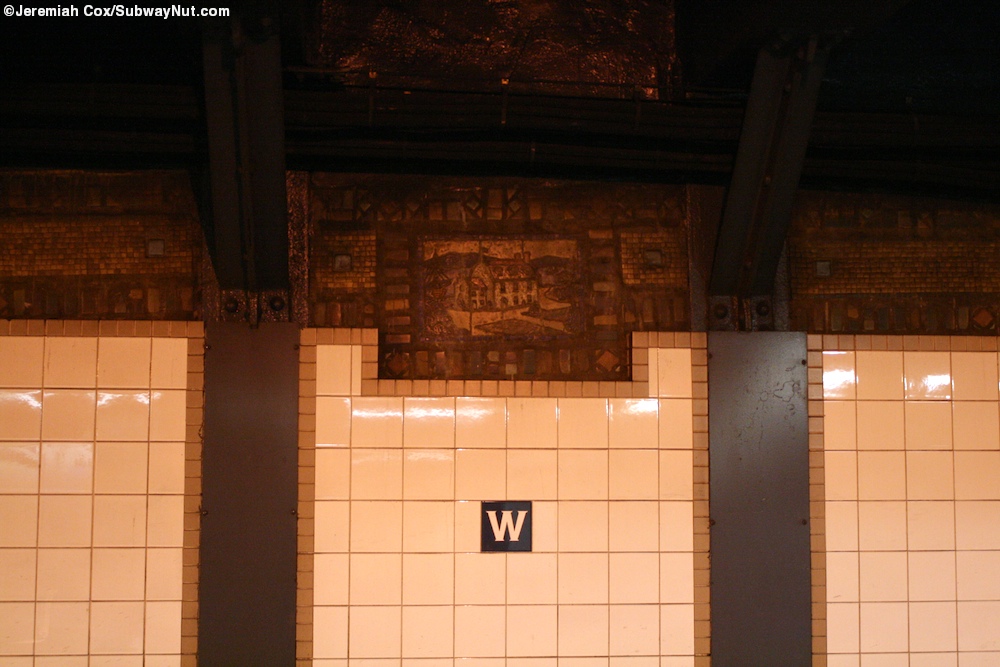
So on Saturday we found ourselves emerging from the Whitehall / South Ferry subway stop to get on the ferry. The station has recently been revamped at a cost of $530 million. But on the R platform there are still traces of the old mosaic frieze showing the nearby Customs House, along the top of the wall.

On the ferry I had that feeling of relief at the expanse of a bay. The dramatic meeting of a city and the sea is invariably inspirational. Of course being on the Staten Island ferry ain’t the same as being close to the water on a sail boat. The ferry's bulk and the press of fellow passengers, a mix of Staten Island residents and camera-wielding tourists, intervene. Maybe it’s a more appropriate way to experience this particular bay though. After all, the poem on the Statue of Liberty's pedestal welcomes the “huddled masses”.

After the return trip we hunted for somewhere to have lunch. That’s no mean feat in the Wall Street area at the weekends. We passed plenty of closed places and the occasional un-enticing sandwich shop. Then we serendipitously stumbled upon the annual Stone Street Oyster Festival. By that time JNH and CMH were asleep so we could enjoy pulled pork mac n’ cheese (yes both together, sounds strange but was delicious) and a pint of Guinness at a sidewalk table in peace.

Sunday, October 23, 2011

New York missive no 96 - Occupy Wall Street, the map of Taiwan, slavery in rural & urban areas


The man on the corner of Sixth Avenue and 28th Street comes and goes. When he’s gone he invariably leaves a trace, like this one.

*********************

My fascination with all things maps continues. I learned recently that Taiwan is sometimes referred to as a sweet potato because that’s what its shape looks like when viewed on a N-S map. And that when viewed W-E it looks like a whale.

*********************

Recently I finally read Frederick Douglass’ Narrative of the Life of Frederick Douglass, an American Slave. One of the many things that struck me about it was his descriptions of the differences between how slaves were treated in the city and the countryside. Such as this one:

“I had resided but a short time in Baltimore before I observed a marked difference, in the treatment of slaves, from that which I had witnessed in the country. A city slave is almost a freeman, compared with a slave on the plantation. He is much better fed and clothed, and enjoys privileges altogether unknown to the slave on the plantation. There is a vestige of decency, a sense of shame, that does much to curb and check those outbreaks of atrocious cruelty so commonly enacted upon the plantation. He is a desperate slaveholder, who will shock the humanity of his nonslaveholding neighbors with the cries of his lacerated slave…”

It made me think about cruelty in urban and rural areas today. Can the same be said, that in an urban area people are more aware of what their neighbors are doing so they behave better? The density of housing is such that in many cases I’m sure that’s not the case anymore: abuses can be buried in the crowd, and even when they’re noticed often people won’t want to intervene, hardened as they are by it, or used as they are to not interfering with others’ business.

*********************

I think that ports and peripheries are where the heart of a city can be found. In Manhattan, not that it’s a city in and of itself, there is little port and periphery left. But there are remnants of them on the far West side of Midtown. A few Saturdays ago J and I arrived over there early for his swimming class. He was asleep so I passed the time walking in a loop down to the river and back, along streets in the 50s.

On the walk we passed symbols of how the city functions. Of how the basic dynamic is one of wealthy people living it up and poor people working to keep them doing so. We passed gleaming car garages. I had no idea there were so many out that way. The cars posed in their glass-walled showrooms like frozen zoo animals. We saw two massive docked cruise liners spewing out their passengers who emerged onto the city streets with an air of conquest, and spewing out their workers who crossed over the West Side Highway straight to a call center to speak with home. We got a glimpse into the stable where the horses who pull carriages for tourists in Central Park are kept. It was gloomy in there. And we saw a man cleaning out the stable, tipping horse poo into a steaming bin.

*********************

I’m glad that the Occupy Wall Street protests and related movements around the world are focused on national governments. That’s as opposed to past protests with more international targets, like the 1999 “Battle in Seattle” against the World Bank. Because ultimately it is the governments that individuals, in democracies, have voted into power, and so we should, if things were functioning ok, have some influence over how that power is used. The fact that we don’t is the heart of the matter.

I recently re-read the final chapter of Joel Bakan’s The Corporation and again was convinced by his argument: that given corporations in their current form are only legally accountable to their shareholders they cannot be expected to act in anyone’s interests but their own unless compelled to by the governments that created them (“incorporated”) them in the first place. “Many among the corporate elite and their defenders would likely sing ‘Hallelujah' the day activists against corporate abuse abandoned government,” he says.


(sign down in Zuccotti Park)