Monday, December 31, 2012

New York missive no 124: On fallible online maps and the purchase of a globe

A friend recently described how she is in awe of Google maps for i-Phone. She had emerged from a subway stop in Manhattan, and unable to get her bearings flipped out the phone and checked her location on the map app. It promptly let her know she was walking in the wrong direction. I myself had been using Google Maps a lot recently – the online version – for a house hunt in Astoria (now temporarily put on hold). I would zoom in on a house for sale to get a feeling for the extent to which its real surroundings differed from those described by real estate agents.

Online maps can give a sense that they miss nothing. As Simon Garfield, author of the forthcoming book "On the Map: A Mind-Expanding Exploration of the Way the World Looks," said: “The uncertainty that was once an unavoidable part or our relationship with maps has been replaced by a false sense of Wi-Fi-enabled omnipotence.” His word “false” is key. Today’s maps may not be as prone to mistakes and omissions as the earliest ones, but they are no means free from them.

In November, a group of scientists set out on a boat to “Sandy Island”, about 1200 km off the coast of Australia. It appeared on several maps, including Google’s. When they arrived at the spot where it should have been, the island was not there. At first I wondered if that could be because of rising sea levels caused by climate change. It turns out that the island’s non-existence was likely the result of a different kind of human error.

A librarian at Aukland Museum (hooray for librarians!) found an early sea chart that implied the island was “discovered” by the whaling ship Velocity in 1876. The ship’s master had recorded “heavy breakers” and “sandy islets” in the area. The librarian, Shaun Higgins, believes that over time mapmakers may have started to consider those as a landmass. The sea chart had included a sensible disclaimer: “Caution is necessary while navigating among the low lying islands of the Pacific Ocean. The general details have been collated from the voyages of various navigators extending over a long series of years. The relative position of many dangers may therefore not be exactly given.” (That wonderful last sentence could apply to so many things beyond a map.)

I recently encountered the fallibility of online maps much closer to home. I wanted to get the name of the store at 34-03 30th Avenue in Astoria. Given my 30th Avenue blog, Alfred Holzman, who grew up along the Avenue in the 1940s and 50s invited me to a reunion lunch he had organized with 23 of his primary and junior school classmates, all now in their seventies. His Slovakia-born parents had run a paint and decorating store at 34-03, and the family lived above it.

When it came to writing up the story I wanted to include that detail, as well as what the store is now. I remembered it is a printing store but had not checked the name the last time I walked past. I lazily used Google Maps’ street view feature to get the name. “Prime Design & Printing |Prime Brokerage”, the image of the store sign on my screen read, and that is what I wrote. The next day I walked past and saw that it is now called simply, “Prime Design & Printing”. A minor change, but I corrected the story.

The two places – Sandy Island and Prime Design & Printing – are reminders that online maps, with all the sophistication of features like satellite imagery, give the illusion of presenting current reality while in fact they do not. Nothing is a substitute for being physically present in a place. Hopefully nothing ever will be.

That said, I did still buy an outdated globe the other day. My fascination with maps is still in tact. After all, it is their limitations and flaws that make them interesting, a bit like people. I was walking back from the 30th Avenue subway station to pick up six month-old CMH from his daycare. As always I was rushing to make sure I was there by six o’clock. I passed the store “Old Village Thrift, Gift and Antiques”, whose owner Sami Mobarak had been one of my 30th Avenue interviewees. Perched at the back of the cluttered table outside the store I glimpsed the globe. I asked Sami’s wife how much it cost and she told me $15. I said I would probably be back to fetch it the next day - I was in a hurry and carrying a lot of stuff. A few paces further along I found myself turning back to buy it. I was excited about giving it to JNH (now two and a half), and worried that someone might snap it up before me.

It reminded me of when my paternal grandfather turned up at our house one Christmas with a big box. I was about eight or nine. He told my sister and me that it had a monkey inside. I remember distinctly the feeling of disbelief combined with a glimmer of hope that maybe, just maybe, he meant it, and there really was a monkey inside. My heart beat a bit faster as we opened the box. And it sunk with disappointment when we pulled out a globe, even though it was the kind that lit up when you plugged it in.

Over time the globe grew on me, as the excitement about the monkey-that-wasn’t waned. My childhood friend E and I spun it around to choose a place to “travel” to in our games, taking colored candies along as our malaria tablets. When I was old enough, my real globe-trotting tendencies kicked in. I wanted to feel the places on maps in the flesh, albeit becoming increasingly aware that passing through somewhere does not provide a taste of living there. There is a certain sameness to experiencing different places as an outsider.

JNH is delighted with his globe. He calls it his “gloobe", for some reason. He is learning to point out where he lives – New York – and where his grandparents and aunts live, scattered as they are between the UK, Switzerland, Florida and Dominican Republic. There may come a day when he asks what that big green country labeled “Union of Soviet Socialist Republics” is. Or why South Sudan does not feature. That will present a good excuse for a history lesson: on how the way things are portrayed is not what they are. And on how the way things are one day, they may not be the next.

Tuesday, December 25, 2012

New York missive no 123: Re-creation of Christmas memories, and two offline times

The week before Christmas. People were buying more than usual: not only more things, but bigger quantities. That was evident in 30th Avenue’s Trade Fair supermarket the other day, when the guy in front of me bought 20 bunches of cilantro (total $15). Up the road in International Meat Market, where despite there being plenty of other butchers along the street everyone goes and endures the consequent long queues, a woman called April who seemed to know everybody bought eight huge marrow bones to turn into stock.

***************************

Christmas, it seems, is about trying to re-create the best elements from your childhood experience of it, finding they turn out differently, and then realizing that’s the whole point.

Our Christmas so far has included a mix of things from my childhood and from C’s. On Christmas eve, we ate pernil – Dominican-style roasted pork – that C had marinated for a day and half beforehand in garlic and spices: the result, juicy and delicious, served up with rice, beans and plantains.

Then this morning, after JNH and CMH (with the former’s help) had dug Santa-delivered presents out of the the army socks that my grandfather had worn in World War II and that my sister and I had always used as our Christmas stockings, we had a britishy brunch of scrambled egg and smoked salmon on brown bread (washed down with a glass of champagne), albeit to the accompaniment of Merengue.

Right now, while JNH and CMH are very rarely both asleep at the same time and C is out at a basketball game, I've turned on BBC World service. (I should be catching up on sleep myself, but there's always that trade-off between using those quiet moments for valuable "me"-time or loosing them to much-needed sleep).

We’re spending the afternoon at L and A’s place near Central Park, with a bunch of others. There, no doubt, will be traces of their Armenian and French upbringings mixed into the proceedings.

***************************

Recently we’ve had two five-day periods without internet and cable TV access. Not because of hurricane Sandy, but because trucks from the construction site opposite had sliced through the cables that run from our home to the other side. Here in Astoria pretty much all the communications and power cables are above ground, with the resulting tangled messes, and tied-together pairs of shoes caught up in them, flung by party goers on their ways home.

Being offline had the combined effect of freedom and isolation. Without emails to check, websites to surf, online videos for JNH, TV to watch, we had to speak to each other! And found plenty of ways to entertain ourselves, as well as ways around the supposed information-deficit. I bought a newspaper. When we couldn’t access our online music lockbox, we played CDs. I even proposed to C that we have a self-imposed offline day each week from now on, which didn’t go down well. And of course as soon as we got hooked up again, on went the gadgets and consumed our attention, as if we were glugging a relieved drink after passing through a media desert. (Which anyway had not been the case, as we’d both been online at work during the days).

The fact the cut off was the result of a fallen cable is a reminder of the physicality of cyberspace. With features like “cloud computing” it’s easy to think that the internet is intangible and consequently has a light environmental footprint. Of course that couldn’t be further from the case, as this NYT article “Power, Pollution and the Internet” makes clear.

Friday, November 2, 2012

New York missive no 122 - post-Sandy haircuts and more

Both C and JNH had post-hurricane Sandy haircuts. And our neighbors gave the shrubs in the front and back garden their fall pruning, wrapping the chopped parts up in black plastic sacks. As if to say after the storm, let’s straighten things out, restore some order. (Albeit to unruly hair or gardens).

Of course, that doesn’t stop everything from feeling out of sync and fragile. Western Queens got off very lightly compared to other parts of the city. Some lost power (our block was lucky and had power throughout) and trees came down here and there but there was nothing like the major flooding and widespread power outages of elsewhere. Nor, of course, the horrendous fire that ripped through 100 homes in Breezy Point. Nonetheless there are plenty of signs of lingering disruption.

When we called our local cab firm to book a cab to take my parents to the airport (they’d got stuck for a couple of extra days), the man at the end of the line laughed. He said their firm had no cabs available and he didn’t know of any that did. The disrupted subway system and limits on private cars driving into the city has flooded the taxi companies with demand. (In the end I nabbed a limo driver from under the subway tracks at 30th Avenue, who jumped up the price because of the lack of gas).

Yesterday when C and I went into my branch of Alma Bank we were seen by a woman who had relocated temporarily from the Ditmars branch, given it was out of power and therefore closed. The queues at the supermarket are long, because people are stocking back up on provisions and because the credit card machines are running sluggishly so each plastic transaction takes a long time. In the butcher's shop, I felt surprised relief to find our Friday night pepper-and-blue-cheese burgers were in stock. "I appreciate it more than usual," I said to the guy who works there, "when places have things I’d expect them to have." "Tell me about it," he replied.

It seems that finally some politicians and media outlets are acknowledging that our recent crazy weather patterns are caused by climate change and there may be more to come. Governor Cuomo said after the storm: “[P]art of learning from this is the recognition that climate change is a reality, extreme weather is a reality, it is a reality that we are vulnerable.” Bloomberg Businessweeks’ cover story headlined, “It’s Global Warming, Stupid."

It’s ironic that as a result of storms like Sandy people are compelled to take the kind of actions that environmentalists have been saying for ages we should take to prevent them. Like sharing cars, taking public transport (such as is available), turning off the lights, minimising flying. As with environmental damage in all parts of the world, it's people with the least resources and who have contributed least to the cause who tend to get hit hardest. And who are likely to be overlooked by measures to mitigate impacts.

It’s a shame it has to take such a major shake-up of one of the world’s richest cities to wake the world’s richest country up to climate change but let’s hope this has been a wakeup call – and not one immediately followed by another hit of the snooze button.

Monday, October 8, 2012

New York missive no 121 - Glacial erratics

In a book about New York's East River I encountered the fabulous term “glacial erratic”. A glacial erratic is a boulder transported by a moving sheet of ice and then left when the ice melts, surrounded by geology different from itself.

The book begins with images and drawings of the East River (which is actually a tidal strait) before it was riddled with human influence. Such as a 1777 view northeast from a scraggy hilltop in what is now Central Park, looking across the expansive “Harlem Plain” to Wards and Randalls Islands. And an early 20th Century photograph of rocky coastline at East Elmhurst, which now lies under the Grand Central Parkway. That photo's caption reads: “By the 1930s, this highway...permanently walled the community from waterfront access except for a narrow, noisy strip of sidewalk.”

Our treatment of the East River has swung between respect and abuse. I won’t be surprised if some day she says that she has had enough and tries to kick us out for good. Native Americans and then the early settlers depended on her for food and transport. With the city's industrialization we clogged up the creeks that fed her – the tidal basin of Flushing Creek became Corona Dumps for example – and turned our backs on her, lining her banks with freeways and runways.

Now there’s an effort to get her back. Mayor Bloomberg has a “Vision 2020” to re-connect New Yorkers to the waterfront. ("Expand Public Access" is the plan’s first goal, but it will be access of a certain kind I’m sure, involving plenty of re-zoning to allow for the construction of towering apartment buildings à la Long Island City).

I wonder what the river will make of this change of heart? The last of the plan's eight goals is "increase climate resilience". That may not be enough to prevent the gleaming new riverside developments from being battered by storms and ultimately swept away by rising tides.

***************************************

EWINY posts may become a bit more sporadic for a while. I'm back to work tomorrow after four months of maternity leave. I've also decided I need to use the precious hour that I have here and there for writing to finish something I'm working on, rather than babble away here!

Monday, September 24, 2012

New York missive 120 - Limits of language, the Staten Island ferry & Stone Street Oyster Festival

Reading a simple story book with JNH the other day I was reminded about the wonder of language. How images in a cave have evolved into sentences on a page (whether paper or electronic). How a combination of letters in a children’s book can spell the word BUTTERFLY, which means butterfly, which gets the child reader thinking of butterflies and remembering butterflies he has seen. Those butterflies may be red, they may be white. Were the butterflies in JNH's mind flying, or sunning themselves on a brick wall?

Language creates worlds and is full of potential. And yet...it is so limited. For people who speak languages that use the roman alphabet, all we have is those 26 shapes and combinations of them to communicate. People speaking other languages are similarly restricted by their alphabets. (For linguistic communication, that is – the spectrum of communication forms that are not part of language, like facial expressions, gestures etc., may account for more than language).

The way to come to terms with it perhaps is to see that restriction as part of its effectiveness. Just as the French Oulipo (“Ouvroir de Littérature Potentielle”) writers saw imposed constraints – such as writing without a particular letter – as opening up expressive potential, so language itself could be seen as a constraint that does just that.

*****************************************

From Astoria Park, JNH saw boats sailing and motoring up East River. He requested to go on one, in the way that two year olds do: "I want to go on a boat." More an announcement than a request. During the week afterwards, he would add, "a sailing boat," followed by a serious nod. I explained that sailing boats are lots of fun but are hard to come by. I said that what we could do though, is go on a big orange boat, aka the Staten Island ferry.

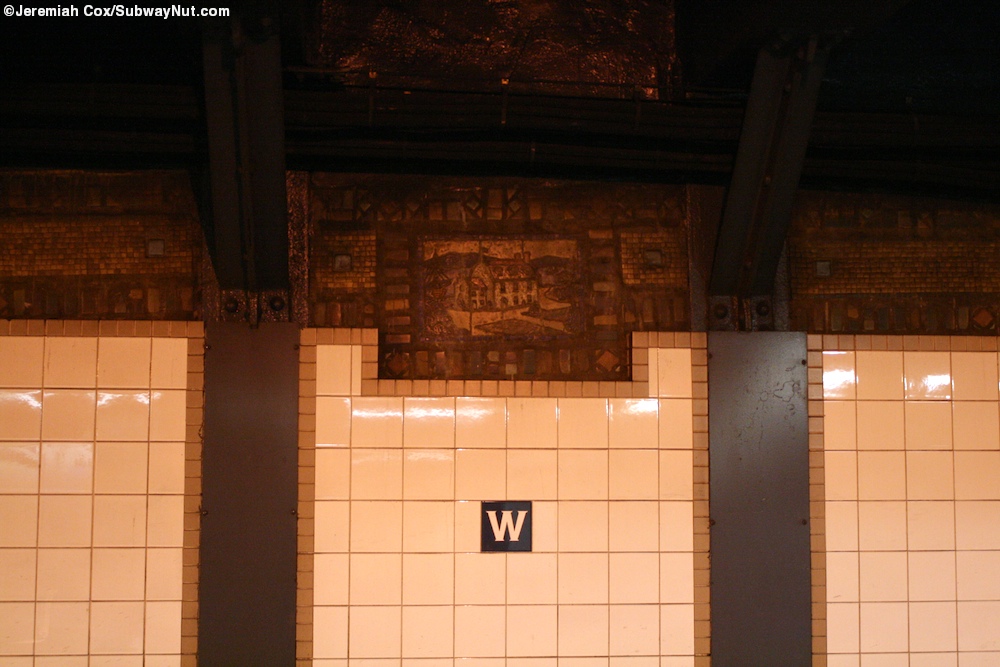
So on Saturday we found ourselves emerging from the Whitehall / South Ferry subway stop to get on the ferry. The station has recently been revamped at a cost of $530 million. But on the R platform there are still traces of the old mosaic frieze showing the nearby Customs House, along the top of the wall.

On the ferry I had that feeling of relief at the expanse of a bay. The dramatic meeting of a city and the sea is invariably inspirational. Of course being on the Staten Island ferry ain’t the same as being close to the water on a sail boat. The ferry's bulk and the press of fellow passengers, a mix of Staten Island residents and camera-wielding tourists, intervene. Maybe it’s a more appropriate way to experience this particular bay though. After all, the poem on the Statue of Liberty's pedestal welcomes the “huddled masses”.

After the return trip we hunted for somewhere to have lunch. That’s no mean feat in the Wall Street area at the weekends. We passed plenty of closed places and the occasional un-enticing sandwich shop. Then we serendipitously stumbled upon the annual Stone Street Oyster Festival. By that time JNH and CMH were asleep so we could enjoy pulled pork mac n’ cheese (yes both together, sounds strange but was delicious) and a pint of Guinness at a sidewalk table in peace.

Saturday, September 22, 2012

Queens' literary scene may be small but it's growing

Brooklyn’s massive book festival is underway this weekend, which is just one aspect of its thriving literary scene. Hundreds of writers have made and still make Brooklyn their home. Meanwhile reams have been written about Manhattan and by its inhabitants. There’s plenty of material for the “literary map” of that borough. It begs the question, what about Queens? It barely features on the literary landscape. For now, that is.

Few well-known writers live in Queens, and few books are set here. The Wikipedia category for “Queens, New York City in fiction” has just five entries (Manhattan 35, Brooklyn 25). Of course that is by no means comprehensive, but it is indicative. There are various potential reasons for this. Among them are history, aesthetics, the postal system (yes), a working class culture, and languages.

As Evan Hughes says in his 2011 book Literary Brooklyn, in that borough “the story of the place is legible and ‘a feeling for tradition persists’" (quoting Carson McCullers, writing about Brooklyn in the forties). He then quotes L.J. Davis who says that on many Brooklyn streets “the 19th-century city is surprisingly intact and, in parts, it is unusually handsome…Writers seldom live where it is ugly, if they have any choice in the matter.” Queens is not, on the surface of things, steeped in history nor beauty.

In 1830 it was still rural, with a population of under 10,000. By then Manhattan had become the largest city in the Western hemisphere and Brooklyn was a major city in its own right too. Queens' development stepped up as railroads arrived, factories opened, and it became identified as a destination for the juxtaposed purposes of urban recreation and burial grounds. However it was only after the consolidation of New York’s five boroughs into one city in 1898 and the arrival of the subway system soon after, that its development really took off.

In reality, Queens is hardly history-free. You just have to dig deeper and look harder to get it. Some of its roads still follow the routes of the trails used by Native Americans before the Dutch arrived. The 1657 “Flushing Remonstrance” that granted Quakers freedom to practice their faith is seen as an important precursor to the first amendment to the Constitution in the Bill of Rights. The waves of immigration into the borough, and its workplaces ranging from factories, to power stations, to family-owned stores, contain no end of material for writers.

Then there’s appearance. Queens' landscape is, for the most part, one of haphazard functionality. An anthology of writing by Queens-based writers that came out in 2011 is tellingly called Forgotten Borough – Writers Come to Terms With Queens. Its Queens-born editor Nicole Steinberg says in her introduction, “It’s not the prettiest borough; upon first glance, not the most memorable.” Personally, give me a rail yard, an auto repair shop, a cemetery, an expressway, an Irish pub, a Buddhist temple or a Colombian bakery to write about any day over a sparkling skyscraper or sedate brownstone, though not all would agree. (Manhattan and Brooklyn, I know I’m generalizing here).

Queens is not “on the map” in people’s minds in a much more literal way too. The US Postal Service does not recognize it as a location. Addresses of places in Queens instead use the name of one of five main towns within the borough – Long Island City, Jamaica, Flushing, Far Rockaway and Floral Park, or sometimes the neighborhood name like Astoria or Jackson Heights. As Kenneth T. Jackson points out in his introduction to The Neighborhoods of Queens, this means that Queens is “not really a place in the usual American sense.” He adds that Queens’ sports teams do not reflect Queens in their name (the New York Mets for example), nor do the two major airports that are located there, John F. Kennedy International and La Guardia.

Another factor is Queens' working and middle class culture. Most of its inhabitants have been and still are people who work too hard to have time to write about their lives. That in itself makes the neighborhood story-rich. Invariably there is more to their stories, than the stories of people who think that their lives are interesting and have plenty of time in which to write about them.

And there are languages. One hundred and thirty-eight languages are spoken within Queens' boundaries. Fifty-six percent of its population speaks a language other than English at home. (More demographics via Queens in Context, here). That means, of course, that thinking about Queens writing has to mean thinking about writing in many languages. How wonderful it would be one day for a novel to be written using all of the languages spoken here. (Any suggestions for how to go about doing that are welcome!).

All that said, there are signs that Queens’ literary life is consolidating and growing. There are the writers featured in the anthology mentioned above, Forgotten Borough. Later this year a new literary journal, Newtown Literary, will launch – it will emphasize writing about Queens and by Queens based writers. (It also welcomes writing from elsewhere: as its website states, “Queens is just as much a state of mind as it is a geographic boundary”).

In Astoria, the closure of one much-loved bookstore, Seaburn Books on Broadway, was swiftly followed by the news of plans for a new independent bookstore, the Astoria Bookshop. Queens Library, thankfully just rescued from major potential budget cuts, is the largest in the US by circulation. The recent book Pax Ethnica - Where and How Diversity Succeeds credits it for playing an important role in making diversity work so well in the borough.

And Queens Council on the Arts has a program called QUILL, “Queens in Love with Literature.” It is a forum for Queens writers who are committed to translation, and offers people in Queens “the opportunity not only to hear from authors working in their own neighborhood, but also perhaps in their own language.”

Queens’ literary scene may be small but it’s growing. Hopefully it will remain uniquely Queens in character.

Wednesday, September 19, 2012

NY missive 119: In praise of the carefully-chosen fragment

In “Essay as Hack”, writer Ander Monson says: “I believe in the fragment. It’s the most honest representation of anything. It acknowledges gaps, its lack of comprehensiveness, its ability to surround and control a subject, an idea.”

I’ve been thinking about fragments recently. Fragments in writing and fragments in life. They are perhaps all we have for knowing and for conveying reality. Yet their importance is so often overlooked in an effort to universalize, to set the big picture, work threads together into a conclusion. Perhaps we should pay more attention to the process of selecting fragments. There is a responsibility inherent in seeking them out, choosing which to linger on and which to pass by.

Fragments can be so many things of course: an image, an action. Or a voice in the crowd. Salman Rushdie recently shared in the New Yorker (extracted from his new memoir) a valuable piece of advice from the professor who taught him at Cambridge, Arthur Hibbert: “You must never write history until you can hear the people speak.”

I’m reading Colum McCann’s “Let the Great World Spin.” The writing is beautiful in many ways. It has a strong rhythm: mostly really short sentences while occasionally launching into a rolling long one. And he is a master of individual voices, whether those of the various narrators or voices that make a brief appearance. McCann has himself apparently described his work as “an accumulation of voices.” The opening scene describes the onlooking crowd’s reaction to the beginning of Philipe Petit’s walk on a tightrope between the Twin Towers (though Petit isn’t named). A pulsating page-long sentence ends like this:

“…and the whole August morning was blown wide open, and the watchers stood rooted, there was no going anywhere for a while, the voices rose to a crescendo, all sorts of accents, a babel until a small redheaded man in the Home Title Guarantee Company on Church Street lifted the sash of his office window, placed his elbows on the sill, took a deep breath, leaned out, and roared into the distance: Do it, asshole!”

Communicating, and particularly writing, is a process of selecting fragments, whether we like it or not. There is something tragic in the fact that we can never grasp an entirety despite our claims to do so. Even those closest to us, we only know fragments of what is going on in their minds, can only know them partially. But so be it. Our memories, and perhaps you could even say our lives, are composed of fragments. So all the more reason to pay close attention to them: watching, listening, retaining. Some just fall by the wayside, some we cling onto. Others get buried in deep pockets to be rediscovered.

*********************************************

In this interview with Colum McCann when he won the 2009 National Book Award, he's asked how he went "about evoking a landscape that would imbue the book with such power and resonance". He replies:

"The place was made for me already. New York is such a vibrant place to write about. Eight million stories colliding all at once. And what a landscape to operate in. The eye never gets tired. Even the garbage can be acrobatic. So I just look for the language that will reflect that. Our language is so deeply influenced by landscape, and vice versa. But mostly for me it has to do with rhythm and sound. As a writer you have to try to find the music of that place. If it’s the west of Ireland it’s a different music to what it is in New York. So I went out and listened to the different instruments that the city plays".

And while I'm gleaning from that interview, there's this, too:

"...my first lesson to my students is that I can’t teach them anything at all. They look a little stunned at first, but then I tell them that it’s all about desire, stamina and perseverance, and if they have that, it will feed their innate talent. And I also tell them to try to write outside of themselves. It is my philosophy that we shouldn’t write what we know. That’s boring and ordinary. Rather, we should write towards what we want to know."